
There are records that document a performance, and there are records that document a place. “Live at St James’s Church, Piccadilly” belongs to a third category: it dissolves the distinction between them. When a master chooses a venue with intention, it stops being a backdrop and becomes part of the composition. Here, architecture does not host sound – it negotiates with it. Running Present – A Contemporary Log is a collection of reviews, descriptions and resonances on experimental, contemporary music and art from Austria.
In Fennesz’s hands, the church becomes an instrument. The sculptural space inhabits the sound, while the sound reshapes the architecture in return. Even through headphones, the music feels monumental, as if the listener were standing inside a structure built from resonance rather than stone. This is not mere immersion; it is spatial authorship. Fennesz constructs a headspace where constraints dissolve and unfamiliar possibilities feel natural.
The church itself is not vast in conventional terms, yet the sound magnifies it beyond physical dimensions. Space and sound fuse into a single capsule, expanded from within. Once inside, external scale loses relevance: galaxies seem to fit inside the room. The listener floats, suspended between material architecture and imagined infinity.
Listening evokes multiple states at once: awe, clarity, relief, stimulation, and a peculiar sense of timelessness. Complexity here resembles nature: layered, intricate, yet intuitively graspable. At times, explanation feels unnecessary, as though pointing at the sky would be enough to convey what is happening.
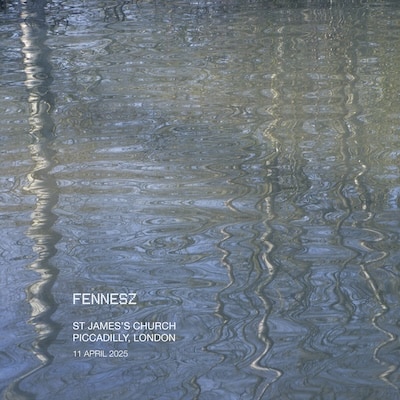
One of the most striking aspects of the performance is how the guitar dissolves as a recognizable instrument. Under Fennesz’s treatment, it becomes multidimensional and expansive. Atmosphere, rather than melody, takes precedence. Composing mood here feels like a different kind of musicianship – not expressing emotion, but constructing the conditions in which it can emerge.
The sonic aesthetic is enveloping, spacious yet finely structured, like the geometry of a snowflake magnified to architectural scale. Particularly compelling are the moments when sound recedes. These brief intervals between gestures open perceptual gaps where form becomes visible. Sound withdraws, space asserts itself, and the mind becomes aware of scale.
It is easy to imagine how overwhelming this performance must have been in situ. Yet the album does not rely on spectacle. Its power lies in sustaining intensity without excess, turning reverberation into meaning and scale into sensation.
Released on Touch, a key reference point for experimental and spatial sound, the recording feels uncannily precise within its lineage. What remains is not a memory of a concert, but the sensation of having occupied a space that was momentarily rewritten by sound.
Serge Bulat