
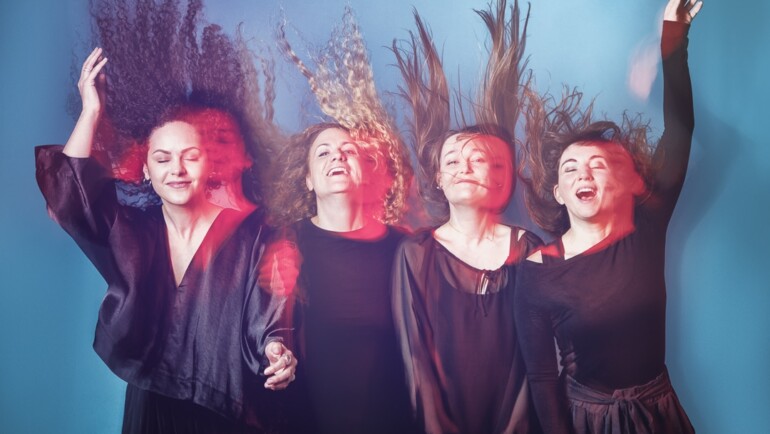
With “free fall a cappella” (Session Work Records; May 16), the vocal quartet HALS presented its debut album—a fascinating interplay of precise technique and free improvisation. Anna Anderluh, Amina Bouroyen, Anna László, and Verena Loipetsberger weave complex compositions with spontaneous sound experiments. Each voice remains distinct, yet merges into a sonic image that at times floats delicately and at others unleashes powerful energy. HALS deliberately breaks with perfection to create space for the unforeseeable. The album invites listeners to experience music as a living moment—open, courageous, and without a safety net. In conversation with Michael Ternai, the four singers discussed their interpretation of the term “a cappella,” the role of improvisation in their music, and the milestone they’ve reached.
Note: This interview was conducted in May 2025. In honor of their upcoming performance at our annual festival KICK JAZZ 2025, we have translated (original German) and re-posted the article. To find out more about the Festival and this year’s 10 year anniversary, go here.
HALS has been around for several years, and you perform regularly. Why did it still take so long for a debut album?
Anna Anderluh: Because the lineup changed several times. The current lineup has been together for about three years.
So it really was time for an album?
Anna Anderluh: Anna and I kept wanting to make an album, even with the other lineups. But then those fell apart—or it was Covid. But yes, it was really time to record these pieces now.
Anna László: It only got truly serious now because the essence of the group has finally crystallized so clearly. Things have come together beautifully. We toured last spring, and after that we decided to tackle the album. This repertoire is ready to be shown.
You mix a lot of different elements from very diverse directions in your music. Such stylistic variety is rather unusual for a cappella.
Amina Bouroyen: I think that happened because a central aspect of our band is that each of us brings in her own pieces—that is, each of us composes and arranges herself. Of course, we share some common ground, since we all more or less come from a jazz or popular-music background. At the same time, each of us brings her own taste and style, which quite naturally leads to a wide musical range—something that probably happens in every band in one way or another.
Anna Anderluh: What really connects us—and this was clear from the start—is the element of improvisation. I got the idea for this formation after taking part in a session at the MIO jazz club in the 16th district. There, everyone took turns organizing a session on a particular theme. When it was my turn, I thought it was a pity that so few female singers usually take part in such sessions. So I planned an evening with female singers and essentially put it together in today’s lineup. The group then came together quite quickly. We felt that there’s far too little improvisation in a cappella groups—or that many don’t dare to improvise. We wanted to create something with the character and feel of a jazz band—but made exclusively with singers. Meaning: lots of open parts.
Anna László: It was also important to us that the a cappella world often thinks in fixed categories—be it the poppy style of groups like Pentatonix, who do fantastic pop a cappella, or the more traditional jazz approach of New York Voices with their classic voicings. From the beginning, we wanted to work across genres. Our aim was to break away from the scene’s stylistic presets and shape a cappella boldly and freely—without fear, without boxes.
A cappella is a beautiful but also challenging genre. We have no harmony instruments; we can’t orient ourselves to a piano or double bass—we only have ourselves. And that’s exactly what makes it so exciting: experiencing the moment when we leave the song, everything opens up—and the collective improvisation begins.
That’s why the term free fall a cappella.
Anna László: Exactly. When we improvise, it feels like a moment of free fall for us—as if we were jumping out of an airplane and saying to ourselves: okay, let’s listen to one another and see where and how we land—and how everything catches us in the end. Doing this using only voices makes it even more exciting than in an instrumental group.
Verena Loipetsberger: Yes, and it’s also about being able to behave exactly like a band. If there’s an improvising soloist in a song, the others take over the accompaniment—but not rigidly; more like a flexible rhythm section that responds to what’s emerging. The accompaniment doesn’t have to be fixed; it can take shape in the moment—in direct interplay with the soloist. That’s incredibly exciting.
Anna László: It’s also fascinating to observe how the audience reacts to these free moments. Sometimes we do wonder whether we might be asking a bit too much of the listeners. But time and again it turns out: people are thrilled to go along. Just recently in Graz at one of our shows—the audience was fully on board. We actively involve people in our concerts and, for example, ask them to spontaneously call out a city or an emotion, from which we then improvise a song. The reactions are fantastic. People join in, listen attentively—and you can really sense how much they enjoy being part of the whole.
You’re all active with your own projects in very different musical areas. Is that perhaps also the reason why you sound so different from many other a cappella groups? Can one even call what you do a cappella?
Amina Bouroyen: I don’t think what we do is so easy to categorize. Of course, it’s vocal music—so in a certain sense it is a cappella. But because our music sounds the way it does, it doesn’t really fit into the classic a cappella drawers. At the same time, it’s not pure jazz either. It lies somewhere in between—or maybe somewhere else entirely. And that’s exactly what I find so exciting and beautiful about our music: that it doesn’t pin itself down right away. It stays open, flexible—and that reflects us, too, because we come from such different musical backgrounds. This freedom, this refusal to be unequivocal, is an important part for me.
There aren’t all that many all-female a cappella groups. Was it clear to you from the start that you wanted to be a band made up only of singers?
Anna Anderluh: No, it just sort of happened—although later on we did consider from time to time bringing men into the band. Ultimately we consciously decided to remain a women’s band. At some point it just became our thing.
Anna László: At the beginning that really wasn’t a criterion. But over time, it crystallized more and more clearly.
Verena Loipetsberger: The only all-female group that comes to mind right now is Soulparlez—they’re performing with us at Theater am Spittelberg. They’re four women as well. But otherwise? All-female groups are rather unusual.
As you mentioned earlier, each of you brings in compositions. How does a piece come into being with you?
Amina Bouroyen: It varies a lot with us. In most cases, one of us brings a composition or arrangement that’s already quite worked out or almost finished. Often the musical idea is already quite clear in the room. But there are always pieces where much only develops in the joint rehearsal process. Then we try things out, change them together, rethink—sometimes entire passages arise through this collective working process. Both approaches have their charm, and it’s precisely this mix of individual creativity and joint shaping that makes our way of working so lively.
Anna László: It’s always exciting when someone comes with a finished piece—and then it suddenly develops in a completely different direction than originally intended. New ideas emerge through singing together, and sometimes you almost have the feeling that the music itself decides where it wants to go. That may sound a bit esoteric, but it happens often: you have a clear idea, and through small changes something even more beautiful emerges than you ever imagined.
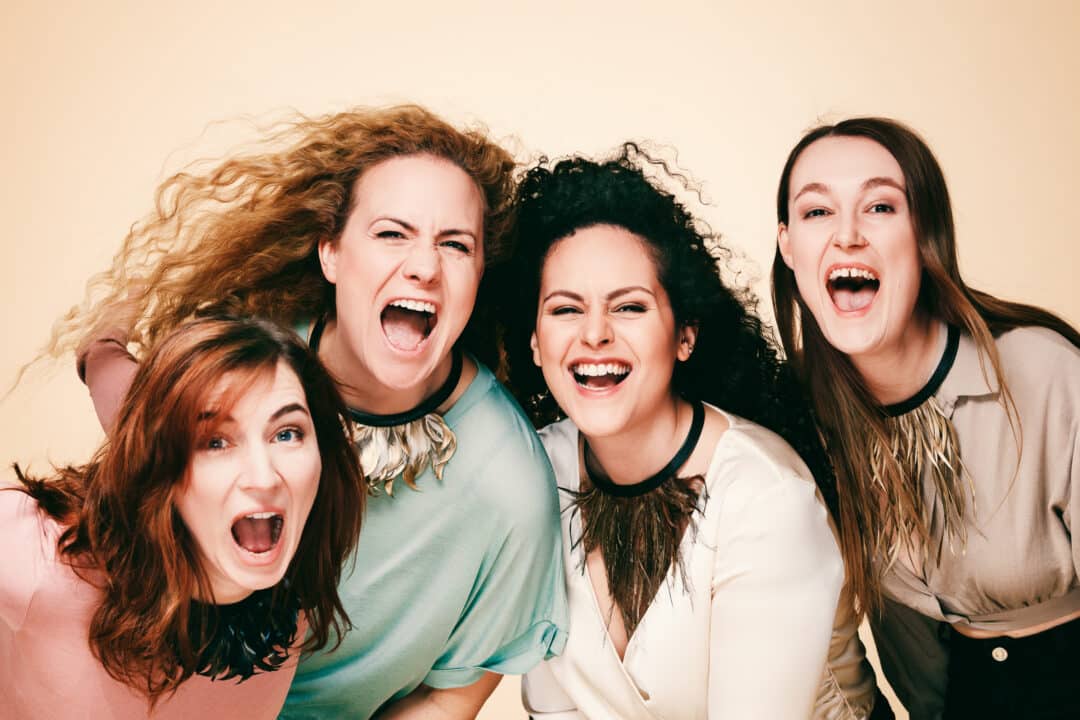
You usually perform in other projects with a band or ensemble behind you. How different does it feel to appear as a purely vocal formation?
Anna Anderluh: It really is something quite different, I think.
Anna László: It demands much more than playing with a band. When four singers are on stage together, each one has to be well integrated not only musically but also personally. You need real soft skills for it to function as a band—not just as four individuals who happen to be singing together. It’s a very special setup.
Verena Loipetsberger: Another big difference is that in an a cappella formation we, as singers, take on many more roles. In a band you’re usually just the singer—but with us the functions are constantly changing: sometimes you take the bass line, then a rhythmic accompaniment, or you sing the lead. That multiplicity makes it more demanding, but also more exciting than in a classic band lineup.
Anna László: Because the voice is so immediate, a lot also has to fit together on a human level. Bodies resonate, souls resonate. That’s not to say this couldn’t happen with a saxophone or other instruments—but to form a unified sound body using only voices, you need a very special connection.
Anna Anderluh: It’s simply important that it truly fits together. We all work with the same instrument—the voice—and we have to pay attention to how our voices blend and merge. What’s decisive is how well you can adapt to one another. If each of us just pushes her own sound without adapting, you won’t get a beautiful chord.
You also sing very differently than in a band where you’re the soloist. There you can freely choose your own sound. With us, everything depends on the function you’re taking at that moment—and that changes constantly, sometimes even within a single piece.
You did allow instruments on one song, though. How did that come about?
Amina Bouroyen: I have to go back a bit. It’s about the piece “Going Round in Circles,” which I composed. I always joke that there are already hundreds of thousands of versions of this song, because I originally played it with another band—in which Robin Gadermaier plays electric bass.
For my master’s graduation concert I performed with both HALS and my trio Slowklang. I thought it would be nice to fuse the two bands at the end of the concert. So I played “Going Round in Circles” with the trio as a closing piece, and the girls joined in. It worked beautifully.
While we were working on the album, we thought the piece could use a special guest. Since the concert had been such a great experience, we decided to bring Robin in—as a lovely special moment at the end of the album.
How far do you take improvisation in a concert? And how much can a piece differ live from the album version?
Anna Anderluh: Quite a lot. But that’s exactly what’s important to us—that it can be different depending on the place, mood, or situation.
Anna László: That’s what makes it so exciting. With us, no concert is ever the same—and I find that incredibly beautiful.
I think you’ve achieved a really nice balance on the album between, on the one hand, a somewhat more melancholic tone and, on the other, a very uplifting vibe. What are your pieces about, content-wise?
Anna László: I think this album is mainly about introducing ourselves. It’s a bit like a long, very beautiful business card for our band. The album reflects—very well, in my view—our current way of working and the way we sing. For me, especially because Anna and I are founding members, it’s also a very special milestone in our development.
Anna Anderluh: There isn’t an overarching theme or a specific lyrical message for the album. But I think the way we understand a cappella—with many improvised moments and the decision to record everything together in one room—is a statement in itself. Of course that brings challenges, especially technical ones. But making jazz or improvised music is, in itself, already a statement—particularly in a time when everything is often highly perfected, quantized, and slickly produced. We consciously accept that not everything can be controlled down to the last detail. In that sense, the album goes somewhat against the spirit of the times.
Many thanks for the interview!
Michael Ternai
Note: This interview was conducted in May 2025. In honor of their upcoming performance at our annual festival KICK JAZZ 2025, we have translated and re-posted the article. To find out more about the Festival and this year’s 10 year anniversary, go here.
Translated from the German original by Arianna Alfreds.